Virtual Serial Port Control by FabulaTech
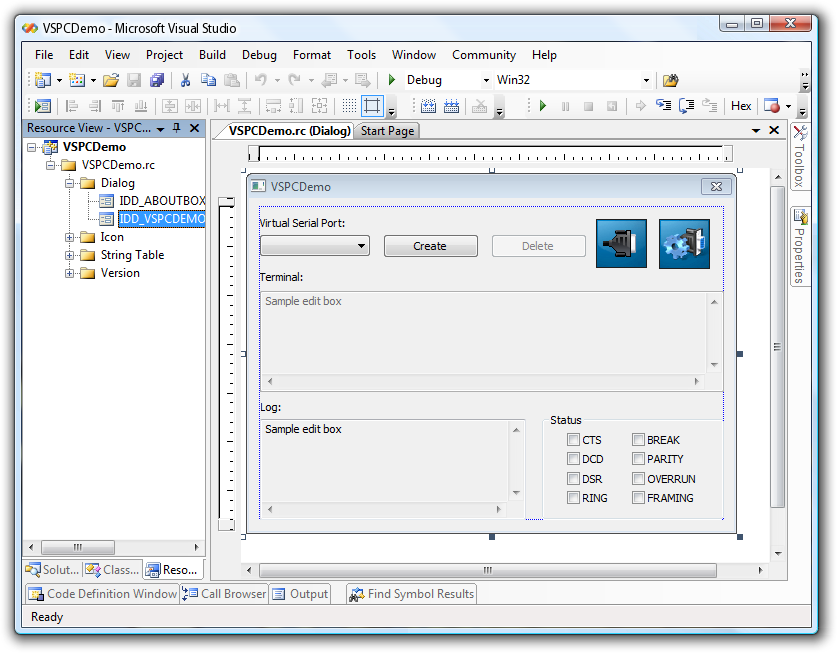
Virtual Serial Port Control is powerful component which makes it possible to create virtual serial ports and control them fully. At the same time virtual ports look like as if they were real hardware serial ports for communications applications.
It is believed that communications applications are intended to work only with hardware serial devices connected to physical serial ports.
If there is a task to provide interaction between communications application and your own program (e.g. hardware device emulator), there is no common solution to accomplish it.

VSPC allows you to create additional virtual serial ports directly from your own program. And any communications application can work with them as if they were physical ports.

On the other hand, developers API provided by VSPC allows your program to access the data written to virtual serial port by communications application and it also allows responding with your own data. The data will be read by the communications application from the virtual serial port as if it were read from a physical port.
The event driven architecture is a soft snap. You don't have to check ports periodically in order to find whether their state is changed or new data is available for reading from the virtual port. Just define the needed function in your program that will be triggered automatically by the appropriate event and that will process the data.
At the same time the Virtual Serial Port Control immediately notifies your application about any actions done to the serial port by the communications application (port opening/closing, setting DTR/RTS handshake, baudrate setting, XON/XOFF symbols setting, etc).
VSPC provides a developer with full control over virtual serial port. VSPC + virtual serial port can as much as a serial device + a physical serial port. Moreover, VSPC drives virtual serial port the same way as a serial device drives a physical serial port.
| General |
|---|
| Virtual serial ports look and work like real COM ports. |
| Unlimited number of virtual COM ports can be created. |
| Virtual serial ports can have the same names as existing hardware COM ports (e.g. COM1). |
| Powerful and intuitive interface to make serial port communications easy. |
| Delivers all the capabilities of the Win32 Serial Communications API. |
| Notifies your application when data arrives or events occur on the port. |
| Supports reading and writing of binary data. |
| Full buffered data transfer. |
| Comes with example applications (Visual Basic, Visual C++, VB#, C#). |
| Can be redistributed as part of your application. |
| Compatibility |
| Full hardware serial ports emulation. |
| Full Microsoft serial.sys compatibility. |
| Serial data bitrate (transmission speed) emulation. |
| Virtual serial ports configuration via Windows Device Manager. |
| PnP and WMI technologies compatibility. |
| Hyper-Threading Technology compatibility. |
| VMware compatibility. |
| User Interface and API |
| Hot Virtual COM port creation and removal, without your computer rebooting |
| Virtual serial ports are controlled directly from your own application |
Virtual Serial Port Control is compatible with Windows 7™.
Virtual Serial Port Control 3.1 released. Virtual serial port driver is improved. Several important fixes are applied.
July 15, 2010Sound over RDP 2.4.1 released. Hyper-V compatibility improved.
July 15, 2010Network Serial Port Kit 5.7.1 released. Virtual serial port driver is improved. Compatibility with MAP110 software is implemented.
June 01, 2010Serial Port Redirector 2.5 released. Optional keep-alive setting is added for Telnet connections. This release is based on updated virtual serial port drivers.
June 01, 2010Network Serial Port Kit 5.7.0 released. Fax-modem compatibility is significantly improved. Now the program correctly detects if a removable serial port (e.g. USB to serial cable) is unplugged.
Virtual serial ports look and work like real hardware ports.